


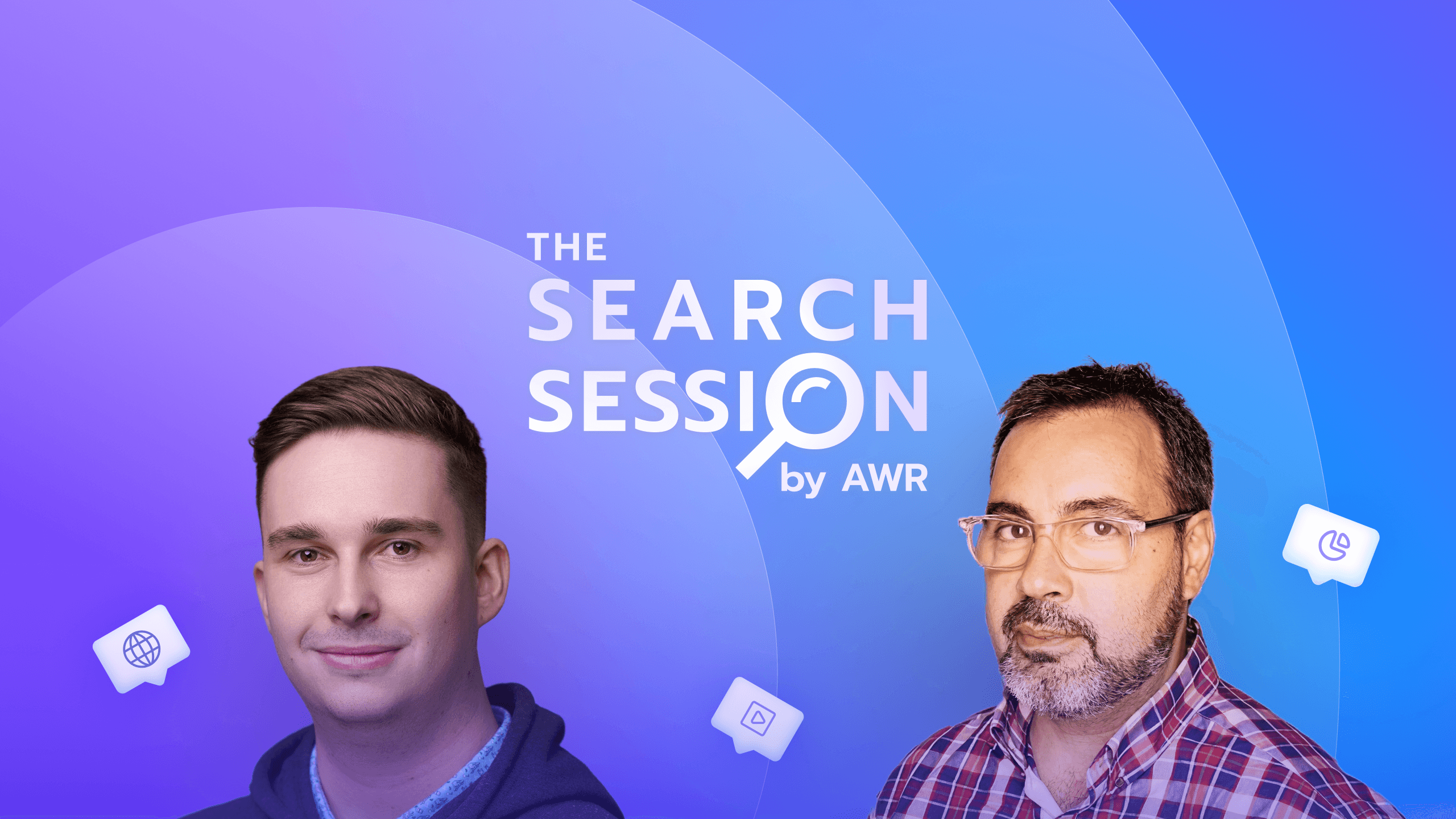
You’re listening to The Search Session with me, Gianluca Fiorelli, and in this episode, I’m joined by Jonathan Moore, an SEO and analytics consultant based in the UK.
Together, we unpack what it takes to do international SEO well in the age of LLMs, from technical complexity and localization challenges to how search is evolving.
We also explore the shift from agency to consulting, Jonathan’s own evolution in building supporting tools for SEO, and the multidisciplinary skills shaping SEO’s next chapter.
What You’ll Take Away
Why local expertise still beats AI in global markets: LLMs carry an English-language bias, and true cultural understanding can't be replaced by AI-generated knowledge.
How to approach international SEO strategically: real success starts with understanding business structure and market context, not jumping straight to technical fixes.
Why hreflang is harder than it looks: the tag itself is simple, but surrounding systems and dependencies create real complexity.
What makes international SEO hard at scale: matching equivalent pages across markets becomes difficult when architectures are disconnected.
Why Jonathan loves international SEO: the real pleasure lies in a lifelong fascination with geography, maps, and understanding how places fit together.
What agency experience can teach consultants: the real foundation for independent consulting isn't just SEO skills but the process, systems, and networks built along the way.
How Jonathan’s traditional tooling evolved into AI workflows: moving from Excel, Python, and BigQuery to LLMs is a natural extension of systems thinking, not a radical shift.
When AI helps and when human judgment matters: automation supports analysis, but classifications, entity matching, and quality control still need people.
How to make your site visible in AI search: the focus shifts from adding signals to pages toward defining entities, attributes, and positioning, then making them accessible to LLMs.
What SEO skills matter most in the AI era: technical expertise now expands into broader multidisciplinary and innovation-focused skills.
Topics covered: international SEO · hreflang · AI & LLM search · technical SEO · hreflang · localization · entity-based SEO · consulting mindset · data workflows · SEO automation · AI-era SEO skills
Settle in, enjoy the conversation, and take a few new perspectives back into the way you approach international SEO.
About the Guest

Jonathan Moore
SEO & Analytics Consultant at Jonathan Moore Consultancy
SEO & Analytics Consultant at Jonathan Moore Consultancy
Jonathan is an independent SEO and analytics consultant based in the UK, with over 15 years of experience spanning enterprise SEO, international search, analytics, and technical problem-solving.
After 12 years agency-side at Equimedia, one of the UK’s largest independent digital marketing agencies, where he held leading roles working with enterprise and global brands, he now advises clients independently. His work combines technical expertise with systems thinking, data workflows, and tool-building to solve complex search and analytics challenges.
Jonathan is also an international speaker and conference contributor, sharing insights on technical SEO, international search, and the evolving role of AI in search.
Transcript
Full conversation between Gianluca Fiorelli and Jonathan Moore.
Gianluca Fiorelli: Hi, I’m Gianluca Fiorelli, and welcome back to The Search Session. Today we are going to have an SEO and analytics consultant as a guest. He is from the UK, in England. We were just talking about London, but he is not from London.
Now he is an independent SEO and analytics consultant based in Cheltenham, but he worked for many years in a big agency, Equimedia, so he is going to be an interesting guest to ask about how it is to work in a big agency and how the transition to consultancy happens, which is more common than we may think.
Our guest is the one and only Jonathan Moore. Hey Jonathan, how are you doing?
Jonathan Moore: Hey Gianluca, thanks for having me on the show. It’s a pleasure to be here.
Gianluca Fiorelli: It is a pleasure for me to have you. Let’s break the ice immediately with a classic question: How is SEO treating you lately?
Jonathan Moore: I think SEO is treating me well. I’m still earning a living; I’m still enjoying it. No two days are the same, which is what I love about the job. I get to solve problems, and I couldn’t be happier. It’s the same, but always changing.
Gianluca Fiorelli: Yes.
Jonathan Moore: That’s the main thing I love about the job. It’s constant change, always learning, and there’s always something new every day.
Gianluca Fiorelli: Yes, it is surely never stopping. It’s change, let’s call it evolution. And talking about evolution, just a curiosity: one thing that always changes is how SEOs define themselves, especially to the public, not among themselves. How do you define yourself? Are you still defining yourself as an SEO and data analytics consultant, or have you started to use one of the many new ways of describing the role? Sometimes I see SEO titles becoming much wider because of all the new things coming out.
Jonathan Moore: I’m still holding on. I still go by SEO analytics consultant, but I must admit I do vary it a bit. Even yesterday, I introduced myself to someone who I wasn’t sure knew what SEO was, so I just said I work in technical marketing.
I try to adapt it. It’s pretty fluid. But for professional purposes, where I know there may be other SEOs, I try to keep it succinct as SEO analytics consultant. That’s what I do. But essentially now, I solve problems. I’m a consultant.
Gianluca Fiorelli: Like the guy in Pulp Fiction. I solve problems.
Jonathan Moore: Yes. I do two things: I solve problems, and I build capabilities for my clients within the SEO, analytics, and data umbrella. If you break it down, that’s what I try to do for people.
AI’s Struggle with Local Nuance
Gianluca Fiorelli: Yes, that’s the most important thing. And as I was saying, you worked for many years, more than a decade if I remember well, at Equimedia. I know it may sound stupid, but when I think about international SEO, it feels more common to know people doing international SEO who are not from the UK and even less from the US, for some reason.
I don’t know, maybe because Spanish or Italian professionals are using languages that are popular, but not the common tongue worldwide when it comes to e-commerce, communication, etc., like English. For this reason, I was not used to knowing people from the UK or the US with a strong knowledge of international SEO.
You are one of these exceptions, if I’m not wrong, because you have always worked with companies and clients with a global presence. So I’m going straight to the big question, which is also coming up quite frequently in recent posts from me, Motoko Hunt, and others.
How are you seeing LLMs and AI models treating businesses with a multi-country or multilingual presence? Do you see some kind of disruption, as people like Motoko Hunt and I are seeing?
Jonathan Moore: I think if we break it down, there is a clear underlying bias behind a lot of these systems. With English being the lingua franca worldwide, everything underlying has been trained on English.
And English on its own is quite a broad church. You have UK English, US English, Canadian, Australian, and so on, and then the English spoken in places like India, where it’s an official language. Even at that level, it’s quite challenging to understand the underlying bias, or who the models have been trained on, and what their perception of the world is.
From that underlying core principle, it then percolates in many different ways. One of my favorite phrases is the stochastic parrot.
Gianluca Fiorelli: Yes.
Jonathan Moore: They all just parrot back stuff to us. I think it’s already challenging in English. As a Brit, you can get frustrated with the differences between UK and US cultural nuances, even though they are subtle.
As someone who is Welsh, I might get annoyed with English-specific references. So you can go up and down in terms of those subtleties.
If we tie it back to non-English speakers, I think there are real challenges in how these systems interpret things. It’s not the same as having a native speaker with real experience in a place or locale, and then surfacing that in a way that is meaningful for that audience.
I think that’s where the disconnect is. It’s the difference between knowledge and wisdom, right? These systems can give you some level of knowledge, but turning that into wisdom is only really possible with someone who is living and breathing in that place. And I think that is a real challenge at the moment.
To see how your brand actually appears to a "native" user in Cardiff versus Chicago, you need more than just a global average.
Advanced Web Ranking allows you to track your rankings down to the city and GPS level, ensuring your "wisdom" reaches the right audience.
Try Advanced Web Ranking free to see your true local visibility.
The Business Logic of Global Search
Gianluca Fiorelli: Indeed. This is usually also a management challenge when we have to work with international SEO. People often associate international SEO only with hreflang, but I think the most complicated thing is good localization.
Not just of the content, but also of less common things like navigation and menus, how they are organized, how they are crafted, and how the navigation is developed. Usually, this is the most complicated part.
I totally agree when we say that a version for American English, or Spanish for Spain, should be done by someone native because they understand the culture, not just the language in the grammatical sense.
When you were working in an agency and now as a consultant and dealing with international SEO, how do you make businesses understand the importance of good localization? And the importance of relying on people who really know the language needed for proper localization?
Jonathan Moore: For me, all businesses are different, but the starting point is probably having a look at how a particular client or organization is structured. Everyone is different there.
I tend to look at it as some form of horizontal and vertical segmentation going on. You have the language, the location, the business unit, and then on top of that, you have this localization layer.
I think if you start by understanding that, it really helps. Mentally, what I’m trying to do is put together a mind map or an organization chart of how that organization fits together and how everything relates to each other.
I think the trap I see a lot of people fall into with international SEO as a holistic term is ending up in a position where you’re trying to boil the ocean, trying to bring all these individual markets on top of each other.
I would frame it differently by getting a real understanding of how the business is structured organizationally and then aligning that with basic information, such as the population of a country, the audience, or the size of the market in that territory.
But that then allows you to start getting an idea of what initiatives are actually going to move the needle and what the size of the opportunity is.
As SEOs, we are really good technical specialists; we have to be. But the drawback is that we are overactive in that skill. So what we do is lead with a solution. The point is, as an SEO, you come in and say, “Oh my God, gold mine! It’s an international site; there is no hreflang.” You are like the kid at school raising your hand to answer the question, saying, “I know, I know, I know. It’s hreflang.”
Actually, I would frame it differently. You still have to go in and spend time looking at the situation. I call it situation analysis. It is about understanding the structure of the company, the market, and the broader economics.
For example, Britain is in a different economic zone than the rest of the EU. We have very different economic dynamics, and that is different again across various parts of the EU.
Knowing all of these things, how they fit together, and their relationships is fundamental to being a good consultant rather than just jumping straight to hreflang.
Gianluca Fiorelli: Yes, exactly. Just as an anecdote, I teach an SEO master here in Spain, a good one, and I am in charge of the international SEO classes. One thing that usually surprises the SEOs I teach is that the first hour of a lesson is just about the questions you have to ask your client for international SEO.
And they are not just the classic questions like, “What technical stack are you using for your website?" which are reasonable from a technical point of view. Many of them are like “How is your company organized?" “Do you have a central office and local offices in the countries you are targeting?” “Do you have a physical presence on Google Maps in those countries, where people can go and talk with you?”
In terms of legal aspects, questions like “Is there some difference between what you can legally do in your country and what you can legally do in the countries you are targeting?” This is very common in pharma, for instance, or even in e-commerce, especially if they are not doing the shipping but they have warehouses. “How is the logistics of your company?”
Because you don’t know how many times I had to do some sort of Sudoku with hreflang in order to show the correct URL, because the logistics required showing a specific version of a website. Otherwise, conversions were lost because everything was working, but in the wrong version.
I think you really touched on a very valid point. We need to ask these questions because knowing these things helps us work better, also from a technical perspective.
Why Hreflang Is Only the Tip of the Iceberg
Gianluca Fiorelli: And talking about technical SEO, you talked in the past about the technical depth of international SEO. I’m sure many people listening to us are asking themselves, "What about hreflang? We know it’s a classic topic.”
Do you agree with me that hreflang is not so complicated, but everything around it makes it complicated? Hreflang itself is relatively easy, but if your canonicalization rules are not correct, it becomes a problem. If the use of noindex is random, hreflang becomes complicated. If you copy and paste the same content in the same language across different countries, hreflang is probably not going to work anyway.
So do you agree that hreflang is not really complicated by itself, but everything around it makes it complicated? Or do you see it differently?
Jonathan Moore: I largely disagree. The analogy I would use is an iceberg. The part of the iceberg we see, the hreflang tag on its own, is relatively easy to understand conceptually. But below the waterline, there is this huge, colossal iceberg of all these other signal systems that can cause havoc.
The difficulty is that the concept is easy to explain to a non-technical stakeholder. You can say there is markup we can add to the page or via a sitemap. The hard part is that stakeholders think it sounds like a sensible thing to do, but what is not always communicated is that all these other elements need to be in place.
Hreflang issues often reveal themselves in rankings before they show up neatly in audits. If the wrong country page is ranking, or visibility shifts between regional URLs, AWR can help you spot those patterns across markets and devices.
Try Advanced Web Ranking for free and monitor whether the right pages rank in the right locations.
Gianluca Fiorelli: Exactly, this is what I was saying.
Jonathan Moore: It then becomes much more of a colossal task to set it up properly. This goes back to my point: we lead with the solution. We have the solution, but we have not fully understood the requirements of what good actually looks like in order to implement it correctly.
There is a whole series of other things that need to be in place, even from a business logic perspective, before you attempt to do the easy part, which is generating it. To a degree, I’m simplifying things by saying it’s easy to generate it. But it’s not.
Like all the things you touched on require logic. Some of that is easy for us as humans to say, “Don’t include that page, include that page, include that folder,” and so on. But actually creating a system that can compute that and generate the file or the annotations is very hard.
That requires skill and a much deeper understanding of what’s going on. It’s the kind of understanding you don’t get just by reading the guidelines on their own.
Gianluca Fiorelli: Yes, that’s right.
Jonathan Moore: You read the guidelines and think it’s easier than it sounds, but from practical experience, we know there are many pitfalls. That’s why I use the iceberg analogy.
Global SEO Pitfalls: Architecture Messes and Platform Limitations
Gianluca Fiorelli: Out of curiosity, even without naming names, what was the most complicated situation—in terms of this logic we have to apply technically in international SEO—the most challenging experience you had?
Jonathan Moore: I had a client where the “boil the ocean” analogy really applied. The challenge comes when the relationship gets out of kilter. The client comes to you as the consultant or agency and says, “We want to do this thing,” and you already know you haven’t pushed that idea because there are obvious flaws.
In this example, from an architectural point of view, you have separate sites, each with a ccTLD. So you’re managing a lot of sites, and none of them really have a way of talking to each other. That’s where it becomes a real challenge.
How do you create a single system that can check all the things you need before generating the annotations or the sitemap? That, for me, is probably one of the most difficult parts.
Gianluca Fiorelli: Yes, doing the matching between different websites can be very complicated sometimes.
Jonathan Moore: In the old days, those were the really hard problems. How do you do that? How do you surface the pages when the platforms have problems with the underlying data structure on each site? It’s like surfacing the equivalent page on each territory or location. Doing it for one to three countries is fine, but doing it across 30 countries is a challenge. Then it becomes a question of effort versus reward.
When managing 30+ markets, manually checking "what good looks like" across ccTLDs is impossible.
Advanced Web Ranking’s international rank tracking centralizes your global footprint into one dashboard, making the logic below the waterline visible and actionable.
Try Advanced Web Ranking for free and simplify your global reporting.
Gianluca Fiorelli: Yes. In my case, it was a very funny case study because it wasn’t even a very big website. The problem was that the client literally decided—and because it didn’t work, it contacted me—to target almost every country in the world. They had dozens of websites, and they were not following a single architecture for international SEO.
Gianluca Fiorelli: Some were on subdomains, some were in subfolders, some were on ccTLDs, and it was a huge mess. They were targeting with hreflang annotations even countries where there was no reason to use hreflang, like some abandoned island in the middle of the Arctic Ocean with only 30 people living there. There was an hreflang for that.
Jonathan Moore: Yes, you see that with Shopify.
Gianluca Fiorelli: Oh yes.
Jonathan Moore: Shopify is a victim of its own success there, because it is really easy to just toggle things on. But you need an underlying sense of geography. Shopify is always the example where you see cases like, in Britain, “We deliver to Highlands and Islands,” which is like the Hebrides, Orkney and Shetlands. Do you really want to be shipping your product there? Or think about places like the Marshall Islands, Guam, or various US overseas military installations. There are checkboxes for all these places, even Vatican City, and the list goes on.
What happens in that ecosystem is that people build a plugin that does this. It is just a for loop running through all those territories where the box is ticked. It becomes very easy to create stuff.
What I find, and one of my favorite phrases is, once the toothpaste is out of the tube, it is very hard to get it back in, especially on a platform like that, where there is not much redirection logic going on.
Gianluca Fiorelli: Exactly. And maybe that is why a Googler like John Mueller said a few years ago that, for him, international SEO is, of all SEO verticals, the most complicated and complex, because of the many things that have to be considered.
The Joy of Specializing in International SEO
Gianluca Fiorelli: One could say that specializing in international SEO is a sort of sadomasochistic pleasure. But I think it is one of the most fascinating SEO verticals. It is not going to bore you anywhere, anytime. What do you really like, as a practitioner of international SEO, compared with other SEO verticals?
Jonathan Moore: I think this comes back to the fact that I like geography. As a kid, I liked things like stamp collecting, learning flags, capital cities, and things like that. I always had a passion for it. And people who know me know I really like maps.
I have a gift, I suppose, for remembering places and thinking visually like that. So for me, there is a natural appeal, because it suits this thing I like about how the world fits together.
Like you’re in Google Maps, you can go up, you can go down; there are different ways to segment geographic data. Even those maps you see on Reddit, or subreddits, all these fun maps. Like the map of Poland showing which parts vote for which political party and how that aligns with things from the past.
Gianluca Fiorelli: Yes.
Jonathan Moore: That is something I’ve always been fascinated by. I have that natural interest, so being able to work with international clients allows me to indulge in that curiosity. You get to learn more about different places and different people, which is fun. For me, it is really rewarding, because I love how it all fits together.
Gianluca Fiorelli: Yes, and somehow that is the same reason for me. As an Italian, as I was telling you before, international SEO and SEO were almost synonyms because if you are not working only with Italian companies targeting just Italy, almost every business in Italy targets at least an English version because of the international market of Italy.
But beyond that sort of synonymy, it is also a similar kind of interest. I think international SEO is the kind of vertical that surprises you all the time.
I remember many years ago working with Chess.com when it was not as famous as it is now. I remember looking at their analytics, and we were always seeing a non-random number of clicks from Antarctica. We kept asking why. It was strange because it was not just the classic two or five clicks per month. It was a constant, significant number of clicks.
That made us realize that, apart from scientists who are obliged to stay in Antarctica—where it can be very boring, especially during winter, so people go and play chess—we discovered there were two permanent little towns in Antarctica, one Chilean and one Argentinian. It was a fantastic way of discovering things through a simple analysis of international traffic. That led Chess.com to create a campaign about these people, obviously related to chess.
This is the kind of thing that makes me love international SEO. Then there are things like a technical stack that makes my mind explode trying to understand how to fix everything in order to make an international strategy work, which is fascinating but sometimes very stressful.
Transitioning from Agency Life to Independent Consultancy
Gianluca Fiorelli: But talking about your experience and your history, you worked for so many years in an agency, in important roles, and then you decided to move to being an SEO consultant. What from those years working in an agency did you bring into your work as a consultant?
Jonathan Moore: I think the important thing to recognize here is that I did 12 years in one agency…
Gianluca Fiorelli: Yes, it’s quite a record.
Jonathan Moore: I’m an outlier, which indicates one of two things: either I’m crazy, or they thought I was not too bad at what I did. Probably a mixture of both.
Fortunately for me, while everyone’s route into freelancing or consultancy is different, I was really lucky. I worked at a good agency, I had good clients, and most importantly, I was shown what good looked like from day one. It was very well run. There were lots of processes, and I learned the value of that.
When I started, in my first role, more as an SEO executive, I’d say I wasn’t work-ready. I really didn’t know anything in those days. But because of the rigor around me, it allowed me to get experience at the right pace for me and develop. And I was fortunate enough to carve out a role within the company doing that.
By the time I left as a member of the senior leadership team, I had a good grounding in things like process, new business, and the kind of skills you need, or at least a good head start in some of the skills you need as a freelancer that are not necessarily SEO-centric.
Things like running key accounts, new business, understanding processes, legal stuff, and all these essential non-essentials you need when you enter the world of being a freelancer and working on your own. I was really fortunate to have built that in an agency environment. That definitely helped me transition into being freelance.
And probably the other thing I didn’t realize was that I was worried about the size of my network as a freelancer. I thought, “Well, I don’t know anyone.” But what I didn’t take into account was that actually I knew loads of people through those 12 years, different colleagues, and different client contacts. It wasn’t nearly as bad as I thought.
I was very fortunate to have had that 12-year stint. It’s not for everyone, but it has allowed me. I’m now five years into being a freelance consultant, and it has allowed me to make that transition.
Gianluca Fiorelli: Well, considering the date, you chose “the right moment” to go freelance. It was when COVID exploded, or not?
Jonathan Moore: Yes, a happy accident. My last day was just before Christmas, and then I had about a month off, pretending I was working when I wasn’t, going to coworking spaces and tapping on a keyboard.
I registered the business about ten days before we went into lockdown. So I had this six-month period of not having much work, but I also had time to really focus. During those six months, I focused hard on processes and building systems. I did a lot of Python programming; this was before the LLM revolution. I spent a lot of time on Stack Overflow, getting better at programming and building things.
Those six months were really helpful because if I had gone straight into client work, I might not have had as much time to set things up. But by the time I started winning clients around September, I had certain things in place. It really helped me in that respect.
On one hand, financially, it maybe wasn’t great. On the other hand, I had this window of opportunity to accelerate my learning, especially on the systems side, which I really enjoyed. It kind of worked out for me by accident.
From Excel to Python: Building Scalable Data Workflows
Gianluca Fiorelli: And talking about that, you were saying you used that time to put your head even more into creating assets, for instance, with Python and so on. And you were just saying that was before the LLMs.
Now that we have LLMs, things like Claude Code, Codex, vibe coding, and all these tools, how was your transition from more classic development, creating your own tools and framework for better analysis and technical SEO analysis, to using AI for improving or creating even more tools?
And maybe the most important question is this: when do you know that you really need something like this, and when do you know that this is something a machine can do, but maybe it is still better to do it the old way?
Jonathan Moore: For background context, when I started, a lot of my analysis was in Excel. And you get to the point where things start to break, especially when you are working on larger international clients. You start worrying about row limits, the time formulas take to update, things like that.
So I went through this process of doing things in Excel and starting to break Excel. And then running into problems like using GA, which was Universal Analytics in those days, where you could get 5,000 rows out in one export. But if I’m working on a site with 120,000 landing pages, how do I get them out?
That is where you hit the problem of scale. You start in Excel and then keep pushing. I was learning a lot from people like Richard Baxter, Mike King, and the things they shared really helped me accelerate my Excel skills. Then you discover things like add-ons or API connectors for Excel.
And then you find out about APIs. At Equimedia, we had a development team, and one of the developers helped me build my first scraper. And it kind of just went from there.
Once I picked up Python, it felt natural because I already had a good understanding of the problem space. Then it kind of clicked overnight, in terms of “Oh, I need to do this.”
Using Google Analytics as an example, even with GA4, I need to do a batch request for these seven dimensions and these five metrics. I need a loop through each 5,000 rows of data and append them at the end. I do that for day one, then day two, then day three, until I tell it to stop. Then I get my million rows and load them in.
By then, I was discovering things like Pandas that can handle millions of rows of data, and I thought, " This is amazing, this is brilliant.” I was already thinking in steps because of the Excel background. Then it became about getting really good at Pandas.
And then GA4 came along with a BigQuery connector, and suddenly, you have the raw data and can write a query to get it all and do all the transformations inside that.
So it is really just building on that foundation. For me, it was through Excel, then picking up Python to do some basic stuff, doing API work, putting that into Pandas, and now moving on to BigQuery and creating workflows with that. It has been really fun learning and acquiring all of that.
As SEO workflows move from spreadsheets to scalable systems, rank tracking data needs to be just as flexible. You shouldn't have to build a custom scraper just to get the data you need.
Advanced Web Ranking was built for this exact level of scale, offering seamless API access and BigQuery connectors to feed your Python scripts and Data Studio reports without the manual export headache.
Scale your data workflows with AWR’s developer-friendly API.
Jonathan Moore: But to answer your question, there are some tasks that maybe aren’t suitable for that. A lot of my work is data-based, like using GA4, Search Console data, and similar sources. Certain things may be quicker using good old-fashioned methods, like classifications. Certain classifications, LLMs may not be as good at. Those are examples where interpretation matters. You have to have a bit more understanding of how machines classify and solve those kinds of problems.
For me, it is about that systems-based signal, that top-down design. Start with the goal, look at each step in the process, and ask whether that step needs human intervention. Then, on top of that, there is quality control and quality assurance at each step, making sure you are actually checking the outputs.
I have definitely had failures when asking AI to interpret something. Classifications are a good example of that.
Gianluca Fiorelli: Yes.
Jonathan Moore: At face value, it looks good, but it doesn’t necessarily pass the sniff test, if you know what I mean, when you actually look at it.
Gianluca Fiorelli: No, no, yes, I see that too. I see it when I use it for things like keyword grouping, in the sense of following a taxonomy or an ontology. I found a way to make it work, but you need a lot of pre-cooking on the data you are going to give it.
This is something many people, by "ingenuity," misunderstand. They just push the data as they have extracted it from their tools and give it to an LLM to interpret, which can be a road to disaster. That data should be pre-cooked first in order for the LLM to really understand what you want to achieve with its output.
And sometimes that step is missing. This is usually where, when I review work done by in-house SEOs, I can trace back the original source of an incorrect strategy.
Jonathan Moore: Yes, most of my work involves some form of closed classification. The initial step for me is looking at the underlying data structure, the frequency of each token I want to classify, and the entities involved to get a feel for what the data looks like. Then I create a closed set of classifications I want to use.
Or I do straight entity extraction, which I often find easier. That can be as simple as using Python, like list comprehension.
Gianluca Fiorelli: Yes.
Jonathan Moore: One of the most common uses for that is geographic data. With Search Console data, I use an API to pull out a list of known locations for a country or locale, and then use list comprehension to match them. That is how I widen my Search Console data geographically.
Gianluca Fiorelli: That’s interesting.
Jonathan Moore: You could say I quite enjoy that. But you have to understand the structure. I use the UK as an example. We have towns, counties, all this fun stuff.
Gianluca Fiorelli: Oh yes. You’re so complicated.
Jonathan Moore: And then, for most of the Google data, you can download all their geographic data, a massive file with all of it. I just have lists on my computer of all these geographical entities, ready for matching.
Technical SEO in the Age of AI and LLMs
Gianluca Fiorelli: Let’s talk, as a last question, about LLMs. You are very strong technically, and usually when people talk about optimizing websites for visibility in ChatGPT and other LLMs, they mostly talk about content, how to structure content, semantics, and so on.
But only from time to time do we hear about the technical side of optimization for LLMs. As a strong technical SEO yourself, what would you suggest other SEOs listening to us pay attention to when it comes to technical SEO for AI search?
Jonathan Moore: I think for me, change equals disruption, and change is constant. We are going through a lot of disruption, which at the same time is an opportunity.
My interpretation of how to leverage that requires deeper embedding within a client’s business. For me, that means being on site more where possible, or running and facilitating workshops. What I want is to understand the client or organization in as much detail as possible.
So my starting point with LLMs now is that you have to understand positioning. Why? I do an exercise with clients where we want to understand what attributes they want to be known for, what the value of those attributes is, and who cares about them.
If you sit down with a client and ask them to fill that in, or you run a workshop around it, some interesting outputs come out. Because this is their view of the world, this may be the audience’s view of the world. Are they the same?
From that exercise, you get an idea that you can start comparing yourself to competitors. You understand what makes you unique, where you are better than others, what aspects are the same, and maybe where you want to improve.
I’m thinking here about attributes, like being seen as good value, being seen as trustworthy, or being really good at fulfillment. All these different things.
As SEOs, I think we really have to understand that, because it is not as simple as saying, put it on the page and hope the LLM will extract it. We have to start by understanding what attributes and entities we want to be known for.
And entities here are, in simple English, those that translate to something known, generally descriptive adjectives.
Gianluca Fiorelli: Yes.
Jonathan Moore: Then that helps you translate it into whether the content actually exists, whether it is written in a way that is easily extractable, and whether the LLM system can access that. That may be significantly different from how we historically thought about writing semantic HTML.
But I think the key difference is actually—and as SEOs, we often like to wing it—spending the time to define clearly the attributes. These are our clients' attributes and the value of those attributes. That is what we want to be known for. And this is the audience we are targeting. It is not just that we are targeting women between 18 and 24 because that is the GA audience bucket.
Gianluca Fiorelli: Yes. Yes. That old-style buyer persona.
Jonathan Moore: It is about actually looking at your first-party data; hopefully, you do have some first-party data and really looking at that data. My point is that this requires a much deeper and more thorough understanding. So that is where change equals disruption, and that is an opportunity cost.
Because doing those kinds of exercises takes time, and it takes money. So it’s either you take the hit on that, or is the client prepared to see the value in it? But for me, that is the starting point. Maybe it should always have been the starting point. The point is, you can’t just go in and randomly put stuff on the page.
Exploring Technical SEO on The Search Session
What does technical SEO look like in the age of AI? Four expert takes on where the craft is heading:
Will Kennard: technical SEO as creative strategy, where experimentation and problem-solving drive innovation.
Jamie Indigo: technical SEO for AI search, from machine-readable signals to optimization in LLM-driven discovery.
Jono Alderson: technical SEO from first principles, questioning how much of our day-to-day work is actually moving the needle.
Chris Green: technical SEO as workflow building, using AI not to write better code but to solve problems faster and with more context.
Gianluca Fiorelli: Oh yes, obviously. And I think in the very beginning of our conversation, when we were talking and joking about the self-titles we sometimes invent for ourselves, you were saying “technical marketer.” Actually, what you just said is a good definition of a technical marketer. Someone doing marketing, asking marketing questions, and adapting that through the technicalities of our work.
Jonathan Moore: Yes, I’ve seen some thought leadership recently, you probably heard of, about having a T-shaped skill set.
Gianluca Fiorelli: Oh yes.
Jonathan Moore: There is a sort of new concept now that maybe we are shifting in the AI era to having an M-shaped skill set.
Gianluca Fiorelli: I remember at one time I was using the Greek pi as a variation of the T-shape, because one side was the technical side and the other side was the marketing specialization. So you have general knowledge about digital and marketing, but then focus deeply on one specific vertical and another specific vertical, and they communicate with each other. I think it is substantially the same, no?
Jonathan Moore: Yes, I think you’re right there. The reality is that in order to be AI-ready in 2026, we are having to evolve our skill sets, our heuristics, almost.
One conversation that keeps coming up for me with business leaders, and it is important, is that they know AI is a huge opportunity. What they don’t know is how to integrate it into their company or organization. They can see that.
And what I find interesting, just talking as an SEO with people working in other companies, is that they are fascinated by the kinds of things we are doing.
I think we are at the cutting edge in terms of early adoption of many of these things that other companies just are not doing. And I think that shows how we can be in a filter bubble as SEOs. But if you look at the wider workplace, there is a lot we can offer there as well.
Not just SEO skill sets, but also process and innovation management. I think we are in a good position as an industry because we have had to adopt fast and adopt early.
Gianluca Fiorelli: Yes, I think we have the experience of being declared dead so many times, and so many times resuscitated from the grave. So we are used to change, and we are used to changing faster. Maybe that is the advantage of SEO compared with other digital marketing professions.
Jonathan’s Passion for Maps, Geography, and Curating Places
Gianluca Fiorelli: So let’s stop talking about SEO. Since you were telling me that when you were younger, you were fascinated by geography and have this passion for maps, I have two questions. Imagine that you are opening a map right now. What is the first country you instinctively look at, maybe a place you have always dreamed about visiting or learning more about?
Jonathan Moore: I like to discover; I’m inquisitive. Sometimes I look for a cue to do the search. I might go on the front page of Wikipedia because there is always an article about a place I haven’t heard of.
Sometimes, and this may sound crazy, I literally go on Google Maps and go to the start of the Danube, and try to follow the Danube on Google Maps all the way to its source. Along the way, you find interesting places, and then I start looking them up on Wikipedia. I have probably done that with quite a few large rivers. I like to play these little games.
But it can be as simple as meeting someone in the industry and finding out where they are from. I’m always curious about that, so I can look it up on a map. Not in a strange way, but just to find out more about that place.
For me, it is really interesting to find out more about your peers and where they are from. You learn more about their culture, and I generally find that very interesting.
Gianluca Fiorelli: Yes, I feel the same. And now that we are speaking about your passion for maps, for those listening to us, you should know that Jonathan and I recently shared in a private group a map of Rome of things to see. I was sure, because I lived in Rome for nine years, that I had included the most interesting things.
Then Jonathan came with his own map, and it was crazy. It was full of things. I was joking with you, saying you even put up a barbershop. That helps people understand better why your map was so perfect.
Jonathan Moore: I’m going to try to do a talk on this, but it is the concept of spotting things, collecting them, categorizing them, and then sharing them.
What I like about maps, or curating maps, is basically the pins. That is my thing. I get ideas from lots of places. It could be reading something online, and I get a lot from places like Instagram.
I can tell you exactly why I saved that barbershop. This is how my brain works. I can remember random things. There are over a hundred things on that Rome map. It was a cool barbershop; I think you could get cocktails there, and maybe a good Negroni, and I think that is why I saved it.
So there are these things I see, and I build up this mental picture of Rome in my head, the places and how they all fit together. Then I buy a book on Rome and save things from there. In fact, I have a book on Rome at the moment that I’m reading.
Gianluca Fiorelli: Okay, Jonathan.
Jonathan Moore: It is interesting, yes.
Gianluca Fiorelli: It’s interesting how these kinds of things help you understand a person better. This attention you have, this love for classifying things, categorizing things, and defining things, we have seen it during our conversation in the way you work. It is not so different. Your mental framework is substantially the same for these things and for your work as an international and technical SEO.
Jonathan, one hour has passed, and it is time to give a break, also to the people listening to us. Thank you very much. Thank you so much for being my guest today.
Jonathan Moore: Thank you. It’s been lots of fun.
Gianluca Fiorelli: Yes, and I hope to see you soon, in real life again.
Jonathan Moore: Yes, fingers crossed.
Gianluca Fiorelli: And maybe in a future episode of The Search Session. Thank you.
Jonathan Moore: Thank you. It’s been a pleasure.
Gianluca Fiorelli: And thanks to all of you. And let me do the YouTuber-style thing: subscribe to the channel and ring the bell to be notified about new episodes of The Search Session.
Thank you, and bye-bye.

Podcast Host
Gianluca Fiorelli
With almost 20 years of experience in web marketing, Gianluca Fiorelli is a Strategic and International SEO Consultant who helps businesses improve their visibility and performance on organic search. Gianluca collaborated with clients from various industries and regions, such as Glassdoor, Idealista, Rastreator.com, Outsystems, Chess.com, SIXT Ride, Vegetables by Bayer, Visit California, Gamepix, James Edition and many others.
A very active member of the SEO community, Gianluca daily shares his insights and best practices on SEO, content, Search marketing strategy and the evolution of Search on social media channels such as X, Bluesky and LinkedIn and through the blog on his website: IloveSEO.net.



stay in the loop